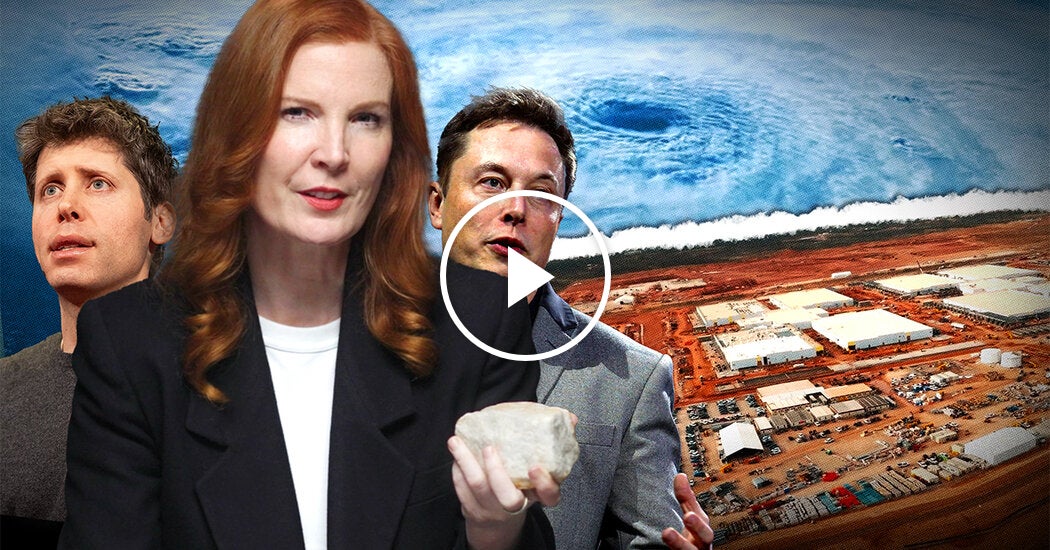
Using artificial intelligence can feel like magic. You type a prompt, and your answer instantly, effortlessly appears. But the magic is an illusion. This one prompt uses roughly 10 times more energy than a standard search. Pull back the curtain, and you discover vast warehouses of computers with a voracious appetite for energy, water and raw minerals. New data centers are fueling a trillion-dollar industrial revolution. “This is the biggest infrastructure project in history.” All of this, quite literally, scars the earth. Right now, A.I.’s environmental impacts are growing, and the consequences are hitting home. “My car is gone.” “I’m OK. It’s OK.” “Everything’s gone.” Spruce Pine is like a secret. It’s a small, sleepy town in North Carolina. Very few people realize how crucial it is in the A.I. supply chain. I came here last fall as part of my work to map the hidden costs of artificial intelligence. I’ve been studying the impacts of A.I. for over a decade. I didn’t realize it, but I was about to see those costs up close and personal. But first, let me show you what I came to see. Below us is the world’s main source of high-purity quartz. As much as 90 percent of the world’s supply of this crucial mineral comes from this five-square-mile quarry. This is what it looks like before it’s mined. This is pegmatite that I picked up in Spruce Pine. It was formed in a rare deposit about 300 million years ago. So what has this ancient rock got to do with A.I.? First, the quartz from these rocks is shipped east to China and Taiwan. The purity and heat resistance make it essential in producing this. A semiconductor microchip. They perform the millions of calculations needed to run A.I. models. But to do this work, they demand vast amounts of power and water. Demand that is expected to dramatically increase in the next decade. “Well, we needed a building. We looked, basically, for factories that had been abandoned, but the —” Take Elon Musk’s company xAI, which boasts that it has built the world’s largest A.I. supercomputer, in South Memphis. Musk calls it Colossus. The local power grid couldn’t support its energy demands, so the company set up dozens of methane gas generators, releasing nitrogen oxides and formaldehyde into the air. This historically Black community was blindsided, and they’re calling for fines and an investigation. “Everyday people don’t get a deal, but Elon Musk does.” In Virginia, data centers already consume more than a quarter of the state’s total electricity. “People’s utility bills may double in the next seven to 10 years just to power data centers. Pollution is rising, and water supplies are being stretched thin.” Worldwide, data centers will soon be using as much energy as Japan and are predicted to match India’s energy usage by 2030. It’s like adding a whole new industrial nation onto the grid. But instead of limiting the environmental impacts, this is happening. “Stargate, put that name down in your books. A new American company that will invest $500 billion, at least, in A.I. infrastructure in the United States.” Just days after he pulled the United States out of the Paris climate agreement, President Trump announced plans to build sprawling A.I. data centers across the country. “The fact that we get to do this in the United States is, I think, wonderful. OpenAI’s new data center, code-named Project Ludicrous, is being built right now in Texas. It’s larger than Central Park. There are plans to construct at least 20 of these across the country. Now generative A.I. will compete with you, for power, water and land. It’s driving up electricity bills while releasing more carbon dioxide into the atmosphere. All of this comes at a cost. “We’re back with more breaking news on Hurricane Helene. Now a very powerful Category 4 storm.” Days after I visited, Hurricane Helene slammed into Spruce Pine. The deadliest U.S. hurricane since Katrina, it killed more than 200 people in the region. The plane that I’d flown in over the mines just a few days earlier, destroyed. The North Toe River, poisoned with sewage, oil, and mining runoff. People had lost everything. With all the focus on the rapid build-out of A.I. factories, what gets less attention are the real risks they pose to our environment. Of course, we can’t pin one hurricane on climate change, but the science is clear. The warming planet will produce more dangerous storms and in places that have never seen this level of severity, like Spruce Pine. This is the reality we face. Now, tech evangelists claim that A.I. will fix climate change in the future. But right now, A.I. is making the situation worse. None of this is inevitable. A.I. technologies could still benefit societies as a whole, or they could enrich a small cadre of interests. Washington has made its choice. It will be up to local communities to take up a grass-roots fight to protect their land, air and water. Because technological progress that isn’t sustainable isn’t really progress. It’s borrowing against the future.




Copyright © 2025 getusn.com