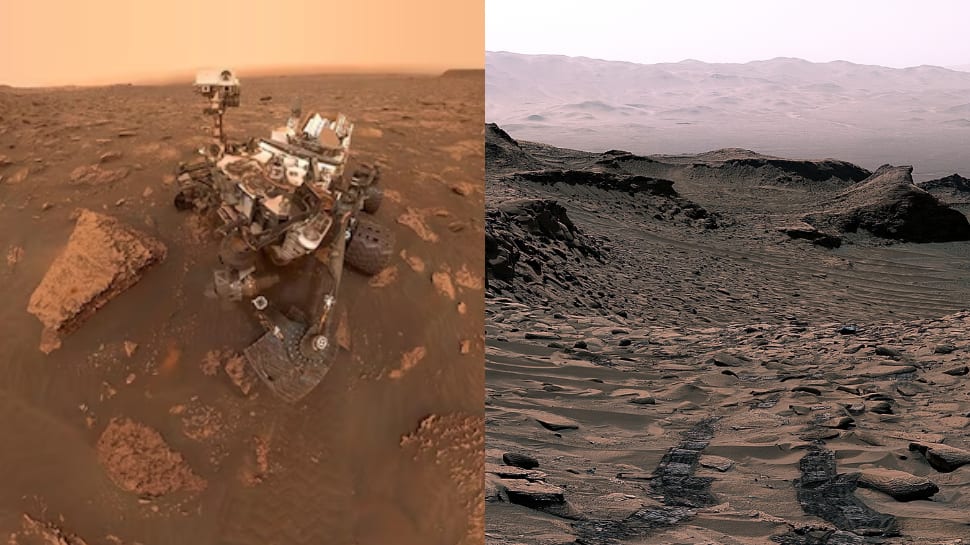
Mars—once believed to have looked much like Earth with vast oceans and a thick, life-supporting atmosphere—is now a cold, dusty wasteland. For decades, scientists have puzzled over what truly caused this drastic transformation. But now, NASA’s Curiosity rover might have just uncovered the long-sought-after clues to this cosmic mystery.
In a groundbreaking discovery, Curiosity has found siderite, an iron carbonate mineral, embedded within the sulfate-rich rock layers of Mount Sharp in Gale Crater. This mineral find could finally answer the burning question: What happened to Mars’ ancient atmosphere?
A Planet That Might Have Been Like Earth
Billions of years ago, Mars wasn’t the desolate planet we know today. Scientists believe it once had a thick atmosphere filled with carbon dioxide, enough to support liquid water on its surface. So naturally, theories suggested that if this was the case, Mars’ surface rocks should show signs of reacting with CO₂ and water to form carbonate minerals.
I found a clue to one of Mars’ many mysteries!
There’s strong evidence the planet had liquid water billions of years ago, suggesting a carbon-rich atmosphere. But where did it all go? My CheMin instrument found a mineral that may help answer that. https://t.co/q1RFfet9V1 pic.twitter.com/pSeAMZssrX
— Curiosity Rover (@MarsCuriosity) April 17, 2025
However, up until now, data from orbital satellites and past rover missions have struggled to find significant carbonate deposits—throwing the theory into question.
The Breakthrough Discovery of Siderite
The Curiosity rover changed the game. While exploring the lower, sulfate-rich layers of Mount Sharp, Curiosity drilled just 3–4 centimeters into the Martian surface and extracted rock samples. These were analyzed using the CheMin instrument—a powerful on-board mineral identification lab.
To the amazement of scientists, the team found abundant siderite, a form of iron carbonate, within the samples.
The second and third samples contained the first rock specimens. Both samples included igneous rock that will be useful as scientists determine the age of the materials in that location. More about all the samples: https://t.co/Mto5mOSADX pic.twitter.com/ug9wVLyTh0
— NASA Mars (@NASAMars) April 18, 2025
“The discovery of abundant siderite in Gale Crater represents both a surprising and important breakthrough in our understanding of the geologic and atmospheric evolution of Mars,” said Benjamin Tutolo, lead author of the study published in Science.
A Peek Into Mars’ Ancient Past
Drilling into the surface of Mars is like peeling back the pages of a planetary history book. Just a few centimeters down, Curiosity unearthed evidence of how the Red Planet once looked—and possibly how it died.
“Drilling through the layered Martian surface is like going through a history book. Just a few centimetres down gives us a good idea of the minerals that formed at or close to the surface around 3.5 billion years ago,” said Thomas Bristow, NASA research scientist at Ames Research Center.
Did you ever collect rocks? The @NASAPersevere rover has gathered the ultimate rock collection — one that could reveal answers to the biggest mysteries of Mars.
Here’s a tour of the samples the rover has collected so far & the stories they may tell https://t.co/xPqSfD1VkZ pic.twitter.com/ndb9ugyKTh
— NASA Mars (@NASAMars) April 17, 2025
These findings suggest that the chemical conditions necessary to form siderite were indeed present long ago. This supports the idea that Mars once had a carbon-rich atmosphere, and the process of its loss may have been slower and more complex than previously thought.
What This Means for Future Mars Research
This isn’t just another rock discovery—it’s a major step forward in solving the mystery of Mars’ climate collapse. Understanding how Mars transitioned from wet and warm to cold and barren is key not only to understanding the Red Planet but also to predicting the fate of planetary climates, including Earth’s.
It also strengthens the search for signs of ancient life, since a wetter and more habitable Mars would have offered more hospitable conditions in the past.
As Curiosity continues to climb Mount Sharp and dig deeper into the Martian past, each rock sample brings us closer to answering one of space exploration’s biggest questions: Could life have once existed on Mars—and what caused it to disappear?