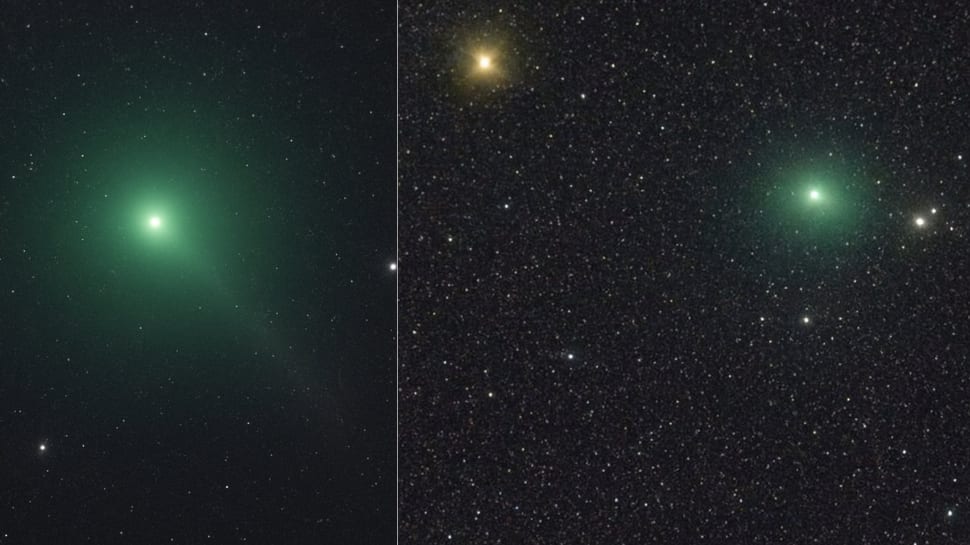
New observations of the interstellar object 3I/ATLAS are raising intriguing questions among astronomers. Recent images suggest changes in the object’s coma, the cloud of gas and dust surrounding its nucleus, providing scientists with fresh insights into its behaviour as it travels through our Solar System and beyond.
3I/ATLAS Coma: What the New Images Show
On December 3, astrophotographer Chuck captured frames of 3I/ATLAS that reveal an unusual symmetric coma with smooth gradients and no visible tail—features that are uncommon for standard comets. The processed images highlight a sharp central point, even coloration, and subtle micro-jets pointing in specific directions. Unlike typical comets influenced by the solar wind, 3I/ATLAS shows minimal shaping, making its coma appear thicker and more isotropic than before.
Add Zee News as a Preferred Source
These details have sparked curiosity about the origin, activity, and trajectory of 3I/ATLAS, as scientists compare it with previous interstellar visitors like ʻOumuamua (1I) and Borisov (2I).
3I/ATLAS Isn’t What It Appears…
Chuck’s Astrophotography captured fresh images of interstellar object 3I/ATLAS on 2 December, revealing a set of features highly unusual for a typical comet. Despite the coma being bright enough to suggest the presence of a tail, none is… pic.twitter.com/wrR3QFOtM6
— Astronomy Vibes (@AstronomyVibes) December 2, 2025
Raw Frame Details
The raw images show 3I/ATLAS against a backdrop of stars. Stabilized exposures confirm expanding coma layers and faint internal patterns consistent with interstellar objects. Long exposures reveal small spikes linked to the nucleus’s rotation, suggesting mild activity changes. Although social media claims of sudden shifts have circulated, none have been officially verified.
Measurements indicate:
Coma intensity: ~88%
Tail visibility: ~22%
Distance from Earth: ~2.4 AU
Distance from Sun: ~2.9 AU
The object continues on a hyperbolic orbit, traveling at nearly 60 km/s relative to the Sun, making it a one-time visitor that will not return.
3I/ATLAS — Interstellar Visitor Shows Powerful Coma Structure
3I/ATLAS Images: https://t.co/00hpNCh9Zx
Captured by Chuck’s Astrophotography • Processed & refined by https://t.co/AxXYWktE5e (Ammar A.) • Dec 2, 2025Today’s observation of 3I/ATLAS (C/2025 N1) reveals one of… pic.twitter.com/LlNXkfRGt9
— SpaceTracker.space (@Ammar1176708) December 3, 2025
Why This Matters
Studying 3I/ATLAS helps scientists understand how interstellar objects behave under solar heating, track dust evolution, and observe potential fragmentation events. Each new observation provides critical data for understanding how comets from outside the Solar System differ from our local long-period comets.
The coma’s symmetry, lack of a tail, faint jets, and smooth gradients are all hallmarks of interstellar activity, distinct from regular Solar System comets. Monitoring such activity informs future studies of high-speed, low-gravity cometary nuclei.
3I/ATLAS Discovery
Comet 3I/ATLAS was discovered on July 1, 2025, by the ATLAS survey telescope in Chile. NASA’s Center for Near-Earth Object Studies confirmed its interstellar origin, marking it as the third known interstellar object after ʻOumuamua and Borisov.
Name Explanation: “ATLAS” credits the discovery program, “I” signifies interstellar, and “3” shows it is the third such object discovered.
Safety: NASA has confirmed that 3I/ATLAS poses no threat to Earth.
The comet passed perihelion on October 29, 2025, and is now moving outward, leaving the Solar System after this brief visit.
As 3I/ATLAS continues its journey out of the Solar System, astronomers worldwide are closely monitoring its evolving coma. Each new observation provides rare insight into the behaviour of interstellar visitors, offering a glimpse of celestial phenomena that are unlike anything found in our own cosmic neighborhood.