BBC News, Washington DC
BBC News, Los Angeles
BBC News, Seattle
 Getty Images
Brent Dmitruk calls himself an earthquake predictor.
In mid-October, he told his tens of thousands of social media followers that an earthquake would soon hit at the westernmost point of California, south of the small coastal city of Eureka.
Two months later, a magnitude 7.3 struck the site in northern California – putting millions under a tsunami warning and growing Mr Dmitruk’s following online as they turned to him to forecast the next one.
“So to people who dismiss what I do, how can you argue it’s just a coincidence. It requires serious skill to figure out where earthquakes will go,” he said on New Years Eve.
But there’s one problem: earthquakes can’t be predicted, scientists who study them say.
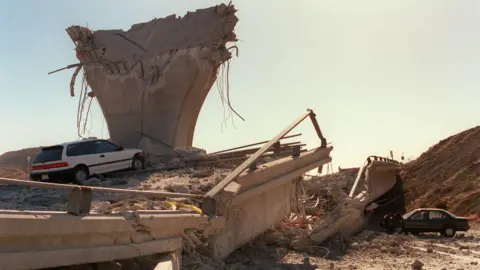
And it’s exactly that unpredictability that makes them so unsettling. Millions of people living on the west coast of North America fear that “the big one” could strike at any moment, altering landscapes and countless lives.

 Getty Images
Lucy Jones, a seismologist who worked for the US Geological Survey (USGS) for more than three decades and authored a book called The Big Ones, has focused much of her research on earthquake probabilities and improving resiliency to withstand such cataclysmic events.
For as long as she has studied earthquakes, Ms Jones said there have been people wanting an answer to when “the big one” – which means different things in different regions – will happen and claiming to have cracked the code.
“The human need to make a pattern in the face of danger is extremely strong, it is a very normal human response to being afraid,” she told the BBC. “It doesn’t have any predictive power, though.”
With some 100,000 earthquakes felt worldwide each year, according to the US Geological Survey (USGS), it is understandable that people want to have warning.
The Eureka area – a coastal city 270 miles (434km) north of San Francisco, where December’s earthquake occurred, has felt more than 700 earthquakes within the last year alone – including more than 10 in just the last week, data shows.
The region, which is where Mr Dmitruk guessed correctly that a quake would occur, is one of the most “seismically active areas” of the US, according to the USGS. Its volatility is due to three tectonic plates meeting, an area known as the Mendocino Triple Junction.
It is the movement of plates in relation to each other – whether above, below or alongside – that causes stress to build up. When the stress is released, an earthquake can occur.
Guessing that an earthquake would happen here is an easy bet, Ms Jones said, although a strong magnitude seven is quite rare.
The USGS notes there have been only 11 such quakes or stronger since 1900. Five, including the one Mr Dmitruk promoted on social media, happened in that same region.
While the guess was correct, Ms Jones told the BBC that it’s unlikely any earthquake – including the largest, society-destroying types – will ever be able to be forecasted with any accuracy.
There is a complex and “dynamic” set of geological factors that lead to an earthquake, Ms Jones said.
The magnitude of an earthquake is likely formed as the event is happening, she said, using ripping a piece of paper as an analogy: the rip will continue unless there’s something that stops it or slows it – such as a water marks that leave the paper wet.
Scientists know why an earthquake occurs – sudden movements along fault lines – but predicting such an event is something the USGS says cannot be done and something “we do not expect to know how any time in the foreseeable future”.
 Getty Images
The agency notes it can calculate earthquake probability in a particular region within a certain number of years – but that’s as close as they can come.
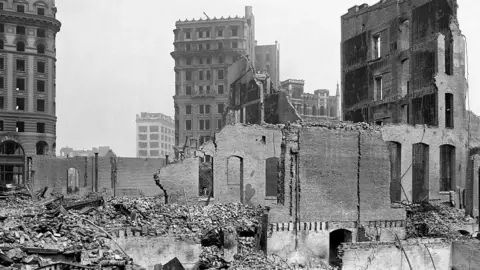
Geological records show that some of the largest types of earthquakes, known as “the big one” to locals, do happen with some amount of regularity. The Cascadia subduction zone is known to slip every 300 to 500 years, regularly upending the Pacific northwestern coast with 100-ft (30.5 metres) tall mega-tsunamis.
While the San Andreas fault in Southern California is also the source of another potential “big one”, with bone-rattling earthquakes happening there every 200-300 years. Experts have said the “big one” could happen at any moment in either region.
Ms Jones says over her career, she’s had several thousand people alert her to such predictions of a big earthquake – including people in the 1990s who would send faxes to her office in hopes of alerting them.
“When you get a prediction every week, somebody’s going to be lucky, right?” she says with a laugh. “But then that usually would go to their head and they predicted 10 more that weren’t right.”
Such a scenario appears to have happened with Mr Dmitruk, who has no science background. He has long predicted an incredibly large 10.3 quake would strike southwest Alaska or islands off the coast of New Zealand, a magnitude so strong he said it could disrupt global trade.
The USGS says an earthquake prediction must have three defined elements – a date and time, the location of the earthquake and the magnitude – in order to be of any use.
But Mr Dmitruk’s timeline keeps shifting.
At one point, he said it would come immediately before or after the inauguration of US President Donald Trump.
Then he said it would definitely happen before 2030.
While that sizeable quake has yet to strike, Mr Dmitruk said he still believes the it will occur.
“I don’t believe it’s just by chance,” Mr Dmitruk told the BBC. “It is not random or luck.”
This type of thinking is common when it comes to earthquakes, Ms Jones said.
“Random distributions can look like they have patterns, we see constellations in the stars,” she said.
“A lot of people are really afraid of earthquakes, and the way to deal with it is to predict [when] it’s going to happen.”
How you can prepare for the uncertainty of a quake
But just because you cannot predict when an earthquake will strike doesn’t mean you have to be unprepared, experts said.
Each year, on the third Thursday in October, millions of Americans participate in the largest earthquake drill on earth: The Great Shake Out.
It was created by a group at the Southern California Earthquake Center, which included Ms Jones.
During the drill, people practise the guidance of Drop, Cover, and Hold On: they drop to their knees, take cover under a sturdy object like a desk, and hold on for one minute.
The drill has become so popular since its inception that it has spread up the earthquake-prone coast to other states and countries.
If outdoors, people are advised to get to an open space away from trees, buildings or power-lines. Near the ocean, people practise fleeing to higher ground after the shaking stops to prepare for the possibility of a tsunami.
“Now, while the ground is not shaking, while it’s not a very stressful situation, is really the best time to practise,” said Brian Terbush, the Earthquake and Volcano Program Manager for the Washington state Emergency Management Division.
Apart from the drills, residents of West Coast states use a phone alert system maintained by USGS called ShakeAlert.
The system works by detecting pressure waves emitted by an earthquake. While it can’t predict when an earthquake will happen in the distant future, it does give seconds of warning that could be life-saving. It is the closest thing to an earthquake “predictor” that has been invented so far.